Lessons from Auschwitz-Birkenau
History A Level and first year student Faith P. recently visited Auschwitz with the Holocaust Educational Trust programme, which takes a large number of students from various schools every year. Their work is to educate students about the Holocaust, who will then be able to spread awareness and create change against discrimination.
Faith wrote this report.
I think this programme is especially important as my generation will most likely be the last one to hear firsthand from Holocaust survivors, which makes it even more important that we are able to fully acknowledge and educate ourselves on the events so we can share our knowledge, to make sure that the Holocaust will never be forgotten or repeated.
-Faith P. 6.1 History A Level student (Communist States in the Twentieth Century)
In March, I went to Poland with the Holocaust Educational trust to visit Auschwitz Birkenau, one of the largest Nazi concentration camps. Here, I learnt about the rich history of the industrial scale of Nazi atrocities, the dehumanisation of over 1.1 million victims, and the fragile nature of human rights. It was a profoundly emotional experience, which forces you to acknowledge the human experience of suffering and resilience, and when leaving, we not only honour the victims but also recognise and combat hatred in all its forms.
One of the many victims sent to Auschwitz-Birkenau, was Iby Knill, when she was just 21years old, however, what makes her unique is that she was part of the few that had managed to escape and share her experience. This was due to a promise she made to a twin girl while in Auschwitz. The girl was being used by the Nazis in experiments, and she knew she would never leave Auschwitz alive. Therefore, Iby Knill was leaving to work in a slave labour camp, and she promised the girl that she would tell the world what she had seen, and she fulfilled that promise. Iby Knill was born in 1923, she grew up in an educated, cultured family where she and her brother, Tomy, spoke several languages. Religion played little part in Iby’s childhood. She attended a German grammar school where she flourished. However, when the pro-Nazi Slovak puppet regime implemented a version of the Nuremberg laws in 1939, she was forced to transfer to a Jewish school.
After the German occupation of Czechoslovakia in late 1938, Iby’s life became increasingly restricted. Jewish people were no longer allowed to sit on public transport and Iby particularly hated wearing the yellow star– she would cover it with her scarf as she walked to school. At the end of January 1942, Iby’s mother was notified by a friend that many young women were being rounded up by German authorities for prostitution on the Eastern Front. Iby hid for several days at her grandparents’ house, while her parents made arrangements to get her to safety. In 1944 Iby was sent to Auschwitz Birkenau. 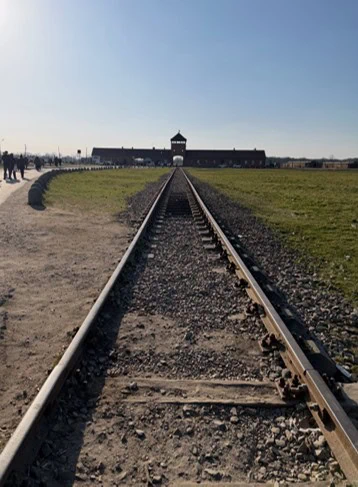
After arriving, Iby was shaved, showered, and given a prisoner uniform before entering the camp. Her language skills were very useful in Auschwitz, as it meant she could communicate in German with the guards, which sometimes resulted in better rations. However, this did not protect her entirely; Iby developed a hip condition, and she ended up in the camp’s hospital. It was then that she underwent X-ray experiments. However, Iby only stayed in Auschwitz for six weeks, because she and some friends volunteered to accompany a slave labour transport to an armament factory in Lippstadt, Germany. Iby’s mother and brother both survived the war and returned to Bratislava. Iby spent some time recuperating in hospital and then began working as a translator and interpreter for the Allied Military Government in Germany. In September 1946, she returned to live with her mother and brother in Bratislava, however, her father perished in Auschwitz. Even though she had returned to her mother she could never had returned to her life beforehand, nor her dreams, or desires. At the beginning of this story was a girl, who excelled in school, and had high ambitions for the future. However, the Nazis depicted the smallest part of her life and made it the biggest problem for them.
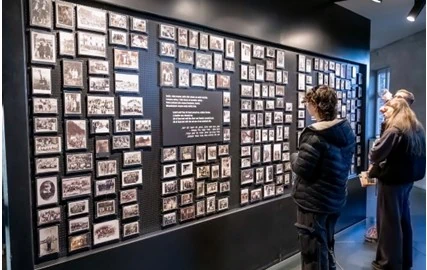
This was exemplified in the Auschwitz camp, block 27, where there were various different videos and projections displayed, depicting pre- war Jewish life. The people I was watching varied across ages, depicting children playing in the park with their friends, adults leaving for a night out, and families having a barbecue together. Watching these videos reminded me of my own upbringing, of how I would race my friends to the park, or help my dad cook the food on the barbecue.
Then I realised, how fundamentally similar my life has been in relation to numerous other Jews. The Jews lives use to be ‘normal’. They used to be brought up with the same values, goals, and ambitions as mine. They used to play sports, go to school, and play with their friends, just like me. The only difference is that my ambitions and dreams remain, whilst theirs were stripped from them completely within a matter of seconds. The only difference between me and the Jews is my race, and to the Nazis that’s all they needed to see. Therefore, to stand in that room and watch a little girl run in her garden across the screen, carrying the same dreams as I once did, to know that she never had that opportunity to fulfil her dreams, alone due to her religion, struck me deeply.
As I stood in the middle of the room watching the various projections, it became clear how the Jews had integrated their own unique culture into all aspects of everyday life. This was captured through the videos in block 27, highlighting the unity between the nation. However, the Nazis did not care for the 100,000 Jewish people that fought for the German army, with 12,000 losing their lives, or the Jewish players which played for the Germany national football team, or the many Jews that were elected officials, party leaders, and government ministers. The Nazis did not want to acknowledge the unity between the Jews, or how they were integrated into all aspects of German life, socially, politically and culturally.
Therefore, when people describe the genocide, yes, it was the systematic murder of approximately six million European Jews, however, it was also the destruction of their culture, heritage and nationality. By destroying the unique aspects that the Jewish people had brought to German society, it created fracture within the national unity.
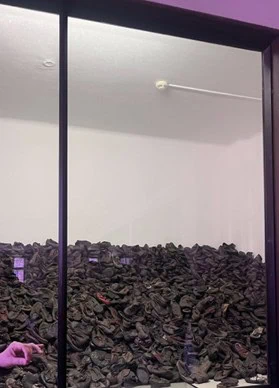 Likewise, with Iby Knill, every individual Jew had their own unique story and experience. These stories are captured through the sheer scale belongings, such as the suitcases, Kitchenware, glasses and the 110,000 shoes. This highlights how many individual stories there are to be told and teach people about their unique experiences.
This point resonated with me most strongly as I stood in the room looking at the pile of Jewish hair. Hair is such an integral part of someone’s unique identity. Therefore, the symbolism of the removal of hair, strips you completely of your individuality and uniqueness. This merely dehumanises the Jews, making them homogenous. This was an important step for the Nazis to complete to be able to carry out the atrocities.
One of the most special rooms in Auschwitz contains a monumental book holding the names of all the Jewish lives that had been taken. If the sheer scale of the persecution of the Jews was not already made apparent through the various belongings, standing and contemplating the ‘Yad Vashem Book of Names’ really brought home just how many people had been impacted. The 4,800,000 names in the book reinforces the significance of the genocide, by highlighting just how many unique, individual lives had been lost.
Even though the Jewish people had everything taken away from them, the Nazis could not take away from them what was held in their hearts. One of the stories I had heard at my time there, was of a Jew that had fought so hard to keep hold of a piece of paper that contained religious meaning. This demonstrates how he was strongly motivated by his faith and sense of community, which were the two things that the Nazis could not strip them of.
This is exemplified by the story of a woman who had fought so hard to work in a horrendous job of physically cleaning out the privy. She had only sought this job, as it was the only time she would receive to be able to talk freely with the other Jews, suggesting the importance of community and human connection.
I am very grateful to have been blessed to visit Auschwitz, as despite the negative measures the Jews had to endure, there still others a spark of light through their resilience of holding onto their sense of community and faith. This trip has not only been incredibly informative, yet has inspired me to share my knowledge, especially due to the decreasing number of Holocaust survivors. Even though we will not be able to hear firsthand stories of the Holocaust, it is necessary that we continue their role of spreading awareness and knowledge of their stories.