Neuroscience Talk Captivates Students
How close are scientists to reading our minds? Students discovered the answer at a packed lunchtime talk from neuroscientist Dr Paul Taylor of the University of Zurich, who explored the mysteries of the brain and the role of AI in decoding it.
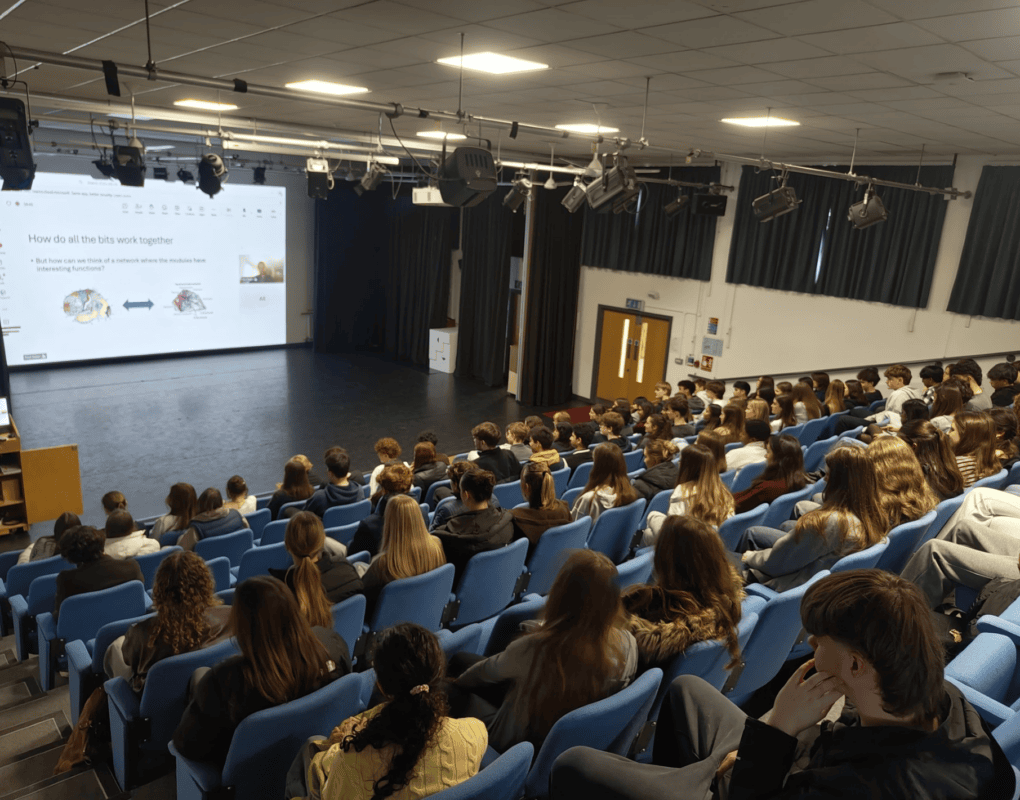
The Biology department invited Neuroscientist Dr Paul Taylor of the University of Zurich to speak on the subject of What we don’t know about how the brain works… and how we’re figuring it out: An insider’s guide to brain decoding and machine learning. The College Theatre was packed with a brilliant turn out of students from Biology, Psychology and other A Levels as well as Applied Science, Health & Social Care and Human Biology Vocational courses.
Dr Taylor who spoke via Teams talked about what he sees as the big problems with neuroscience research at the moment. A key focus was the tension between our understanding how different brain regions are responsible for certain behaviours and the idea of brain networks working together. He also spoke about the difficulty of applying neuroscience research to ‘real world’ situations when a lot of it is conducted in labs as well as a peak into how AI has helped his own research.
In some recent research Dr Taylor and colleagues were trying to decode what people are looking at based on the waveform of their brain responses. Dr Taylor said what they found was ‘beyond their wildest expectations’ because the shape of oscillations on an EEG readout was really different depending on what they were looking at eg. a scene out of the window vs an indoor corridor. They could then use machine learning to decode what a person had been looking at based on their brainwaves. Sounds a lot like mind reading reported some students.
6.1 Jess C. said,
“I enjoyed the talk. The thing that captured my imagination was the idea that there are still questions about how the brain works with different theories. Although I did find it hard to follow some aspects as we haven’t yet learned about the brain circuits so I will be interested in learning more.”
6.2 Christian A. commented,
“It was very interesting to find out what goals researchers in neuroscience have and how AI is used to help reach them.”
Fellow 6.2 Yahya B. said,
“Dr Paul Taylor helped me see how we can decipher activity in the brain while looking at set stimuli to try to understand the methods of the brain. Due to the fascinating complexity of the brain, neuroscientists have continuously pondered the workings of the brain, for as long as the field has existed. His captivating talk enhanced my interest for the human brain, and I am now intrigued to see how far we can go in the future. If we could fully understand the workings of the neurons in our brain, who really knows what that could lead to…”
Dr Taylor urged students thinking about a career in science – or any other direction where you need to show enthusiasm and analytical skills – to grasp new opportunities including reading scientific journals which are now available to access more widely, using AI to analyse datasets available from open sources and finding out about scientific discoveries before their publication (via preprint servers).